Food You Can Take on a Plane: Full List for TSA & International Flights (2026)
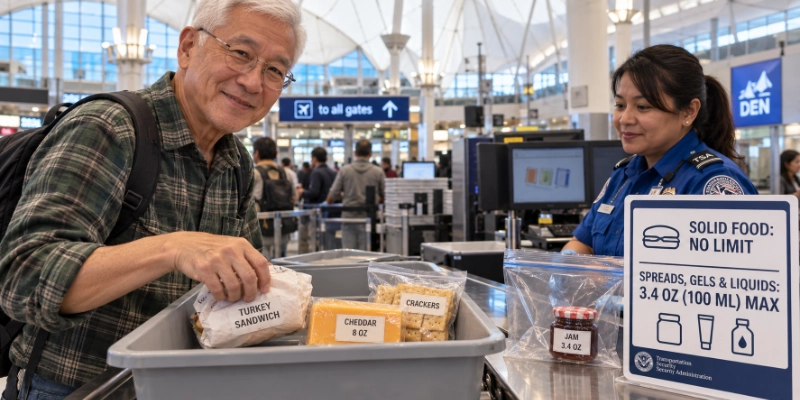
Yes, you can take food on a plane. At TSA, solid food has no limit in a carry-on or a checked bag, and anything spreadable or pourable is capped at 3.4 oz (100 ml) in a carry-on. That one sentence sorts almost every food. The exceptions are frozen food, canned food, baby food, and a few things you thought were fine.
Below is every food and drink on TSA’s own “What can I bring” food list, 55 rows covering all 59 items, with the carry-on answer, the checked-bag answer, and a third column most lists skip: how likely customs is to stop it when you land in another country.
🍽️ Food you can take on a plane: the full list
Type a food in the box. The first two columns are TSA’s own answers for flights from a US airport. The last column is a general guide to what customs usually does, not a promise for one country.
| Food | Carry-on bag | Checked bag | International customs |
|---|---|---|---|
| Bread, baked goods & sweets | |||
| BreadPlain bread is a solid. Fillings change the customs answer, not the TSA one. | Yes | Yes | 🟢 Usually fine |
| SandwichesFine at TSA. Meat, cheese or egg fillings are what customs stops. | Yes | Yes | 🟡 Declare it |
| PizzaA cold slice is a solid. Meat and cheese toppings count at customs. | Yes | Yes | 🟡 Declare it |
| Pies & cakesBakery-sealed is usually fine; fresh cream, egg or meat fillings may not be. | Yes | Yes | 🟡 Declare it |
| Cookies | Yes | Yes | 🟢 Usually fine |
| Crackers | Yes | Yes | 🟢 Usually fine |
| Cereal | Yes | Yes | 🟢 Usually fine |
| Candy | Yes | Yes | 🟢 Usually fine |
| Chocolate, solidMelted chocolate is still a solid at TSA. | Yes | Yes | 🟢 Usually fine |
| Chewing gum | Yes | Yes | 🟢 Usually fine |
| Snack bars | Yes | Yes | 🟢 Usually fine |
| Chips & other snacksTSA lists plain "snacks" as solid food. | Yes | Yes | 🟢 Usually fine |
| Other solid foodThe TSA catch-all: solid food is allowed in both bags. | Yes | Yes | 🟡 Declare it |
| TamalesMeat-filled tamales fall under the meat rules at customs. | Yes | Yes | 🟡 Declare it |
| Fruit, vegetables, nuts & eggs | |||
| Fresh fruit & vegetablesCarry-on is fine inside the US mainland. Most fresh produce cannot go from Hawaii, Puerto Rico or the US Virgin Islands to the mainland. | ⚠️ Special rules | Yes | 🔴 Often banned |
| Dried fruitCommercially packaged is usually accepted; biosecurity countries want it declared. | Yes | Yes | 🟡 Declare it |
| NutsPackaged and roasted is usually fine; raw or in-shell nuts get checked. | Yes | Yes | 🟡 Declare it |
| Fresh eggsRaw eggs are a customs problem, not a TSA one. | Yes | Yes | 🔴 Often banned |
| Dairy | |||
| Cheese, solidHard cheese is a solid at TSA. Dairy is restricted at many borders. | Yes | Yes | 🔴 Often banned |
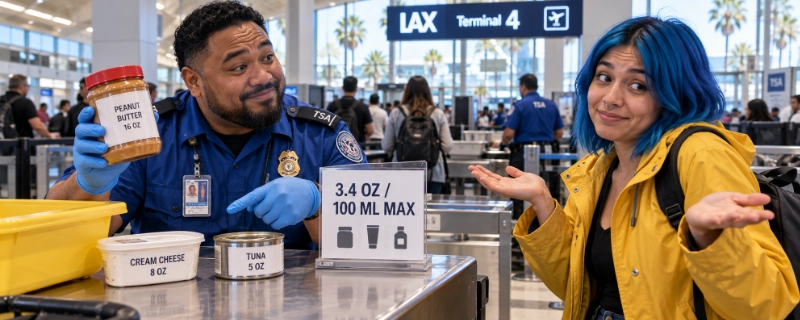
| Cheese, creamySpreadable cheese is a gel under the 3-1-1 rule. | ⚠️ 100 ml max | Yes | 🔴 Often banned |
| Yogurt | ⚠️ 100 ml max | Yes | 🔴 Often banned |
| Ice creamMelts anyway, and it is dairy. | ⚠️ 100 ml max | Yes | 🔴 Often banned |
| Meat, seafood & frozen | |||
| Cooked meat, seafood & vegetables (no liquid)Cooked and dry is a solid at TSA. Meat is among the most restricted foods at customs. | Yes | Yes | 🔴 Often banned |
| Fresh meat & seafoodIf packed with ice, the ice must be frozen solid. Dry ice: 5 lb maximum, vented package, marked. | ⚠️ Special rules | Yes | 🔴 Often banned |
| Frozen foodMust be frozen solid at the checkpoint. Slushy or liquid at the bottom is refused. | ⚠️ Special rules | Yes | 🔴 Often banned |
| Live lobsterClear, spill-proof plastic container. Airline policy applies. | ⚠️ Ask the airline | Yes | 🔴 Often banned |
| Spreads, sauces & liquid foods | |||
| Peanut butterSpreadable means liquid at TSA, even in a sealed jar. | ⚠️ 100 ml max | Yes | 🟡 Declare it |
| Jam & jelly | ⚠️ 100 ml max | Yes | 🟢 Usually fine |
| HoneyRestricted in some countries because of bee disease risk. | ⚠️ 100 ml max | Yes | 🟡 Declare it |
| Maple syrup | ⚠️ 100 ml max | Yes | 🟢 Usually fine |
| Hummus | ⚠️ 100 ml max | Yes | 🟡 Declare it |
| Creamy dips & spreadsDairy- or meat-based dips follow the dairy and meat rules at customs. | ⚠️ 100 ml max | Yes | 🟡 Declare it |
| Salsa & saucesCommercial sealed jars are usually fine. | ⚠️ 100 ml max | Yes | 🟡 Declare it |
| Salad dressing | ⚠️ 100 ml max | Yes | 🟢 Usually fine |
| Oils & vinegars | ⚠️ 100 ml max | Yes | 🟢 Usually fine |
| Gravy | ⚠️ 100 ml max | Yes | 🟡 Declare it |
| SoupsMeat-based soup is treated as meat at customs. | ⚠️ 100 ml max | Yes | 🟡 Declare it |
| Canned foodsTSA says cans may need extra screening and suggests the checked bag. Meat and dairy cans are restricted at many borders. | ⚠️ Special rules | Yes | 🟡 Declare it |
| Drinks | |||
| Water, juice & sodaBuy it after security. | ⚠️ 100 ml max | Yes | 🟢 Usually fine |
| Coffee, liquid | ⚠️ 100 ml max | Yes | 🟢 Usually fine |
| Coffee beans or ground | Yes | Yes | 🟢 Usually fine |
| Tea, dry | Yes | Yes | 🟢 Usually fine |
| Liquid chocolate | ⚠️ 100 ml max | Yes | 🟢 Usually fine |
| Empty thermos or drink containerTake it empty through security and fill it after. | Yes | Yes | 🟢 Usually fine |
| Alcoholic drinks (up to 70%)Allowances vary by country. See the alcohol allowance article. | ⚠️ 100 ml max | Yes (over 24% to 70%: 5 L max) | 🟡 Declare it |
| Alcohol over 70% (140 proof)Prohibited by TSA in carry-on and checked bags. | ❌ No | ❌ No | 🟡 Declare it |
| Baby & pet | |||
| Baby food, including pouchesAllowed over 3.4 oz. Tell the officer; it is screened separately. | Yes | Yes | 🟡 Declare it |
| Baby formula, breast milk & toddler drinksAllowed over 3.4 oz. Tell the officer before screening starts. | ⚠️ Special rules | Yes | 🟡 Declare it |
| Baby juice & waterReasonable quantities, screened separately. | ⚠️ Special rules | Yes | 🟢 Usually fine |
| Pet food, dry or moistAnimal products make pet food a customs problem. | Yes | Yes | 🔴 Often banned |
| Pet food, wetPrescription wet pet food may exceed 3.4 oz with extra screening. | ⚠️ 100 ml max | Yes | 🔴 Often banned |
| Powders, spices & extras | |||
| Protein & energy powdersOver 12 oz / 350 ml goes in a separate bin and may be opened. | Yes | Yes | 🟡 Declare it |
| Spices, dryPlant material: declare it where the arrival card asks. | Yes | Yes | 🟡 Declare it |
| Salt | Yes | Yes | 🟢 Usually fine |
| Gel ice packsFrozen solid only. Medically necessary packs are allowed in any state; tell the officer. | ⚠️ Special rules | Yes | 🟢 Usually fine |
That food is not in this list. If you can spread it or pour it, treat it as a liquid in a carry-on.
🧪 The one test that sorts every food at TSA
TSA does not judge food by what it is. It judges it by how it behaves. Under the 3-1-1 rule, a carry-on liquid, gel or paste has to fit in a 100 ml container inside one clear bag. For food, that gives a simple test.
⚠️ The foods people get wrong
🧊 Frozen food, ice packs and dry ice
Frozen food is allowed in a carry-on and a checked bag, with one condition that decides everything: it has to be frozen solid when it reaches the checkpoint.
🍼 Baby food, formula and pouches
Baby food has its own rule. Formula, breast milk, toddler drinks and baby or toddler food, including puree pouches, are treated as medically necessary liquids. They are allowed in carry-on bags over 3.4 oz and do not have to fit in the quart bag. The full guide is baby food pouches on a plane.
🌴 Flying inside the US: the one fruit exception
On a domestic flight within the US mainland, fresh fruit and vegetables are fine in both bags. The exception is the agricultural border inside the country: passengers flying from Hawaii, Puerto Rico or the US Virgin Islands to the mainland cannot take most fresh fruit and vegetables, because of the risk of spreading invasive plant pests.
🛂 International flights: a second checklist
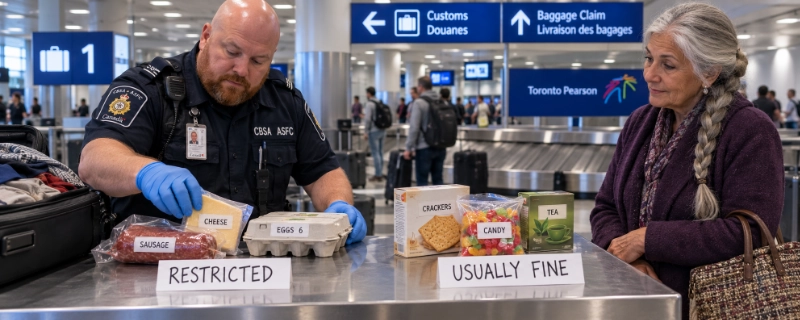
Passing TSA only answers the departure question. When you land in another country, customs asks something different: could this food carry a pest or an animal disease? That is why the last column of the table is mostly red for meat, dairy, eggs and fresh produce, and mostly green for packaged snacks.
 USA — USDA/APHIS restricts most fresh fruit, vegetables and meat; see the US food page
 Australia — among the strictest biosecurity checks; see the Australia food page
 New Zealand — undeclared food is fined on the spot; see the New Zealand food page
 Japan — plant quarantine applies to fresh produce; see the Japan food page
 United Kingdom — see the UK food page
 Singapore — see the Singapore food page
Before you fly — checklist
TSA rules apply to screening at US airports, and other countries’ security rules differ. Customs rules change and each authority has the final word, so confirm current requirements with the destination’s customs or agriculture authority before you travel. Updated 2026.