The 100ml Rule in 2026: What Still Trips Travellers Up
Liquids & Packing·Updated 2026·8 min read
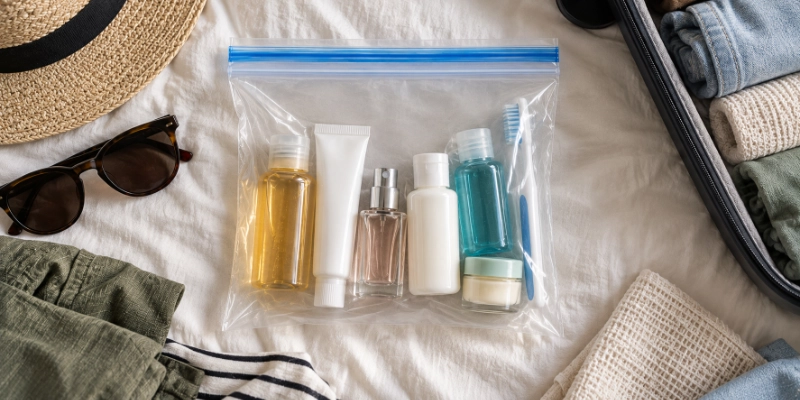
The 1-litre bag — unchanged since 2006, still catching people out daily.
The 100ml rule has been in place since 2006. Nearly every traveller knows it exists. And yet it remains one of the single biggest sources of confiscations at airport security — every day, at every major hub in the world. Not because the rule is complicated. Because the details that matter are almost never explained properly.
Why the rule exists
August 2006 — how it started
✈️
The plotBritish police disrupt a plan to detonate liquid explosives disguised as soft drinks on transatlantic flights.
🔬
The scienceLab testing shows volumes under 100ml cannot be reliably combined to produce a critical explosive mass at a checkpoint.
🛂
The ruleThe 100ml container limit + 1-litre transparent bag is adopted globally within days. It has not changed since.
What counts as a liquid
The rule covers LAGs: Liquids, Aerosols, and Gels. The category is far broader than most people expect.
🧪Creams & foams — foundation, after-sun, body lotion, shaving mousse
🍯Jams, yoghurt, honey — any soft food of similar consistency
💡
Working rule: if it flows, squishes, or can be poured — it is a LAG. Officers have wide discretion. When in doubt, it goes in the bag.
The three rules of the bag
100ml
Max per container — printed volume, not fill level
1L
Max bag size — one transparent resealable bag
1
Bag per person — removed from luggage at the tray
⚠️
Container volume is what matters — not how full it is. A 200ml bottle that is half-empty is still a 200ml bottle. It will be confiscated. Transfer to a compliant travel bottle instead.
Container size ≠ bag size
A 1-litre bag does not give you 1 litre of product. It gives you one bag’s worth of containers, each individually capped at 100ml. Total usable volume is well under 1 litre — typically 500–700ml if you pack efficiently.
Only containers labelled 100ml or less pass through — regardless of how full they are.
What catches people out
❌
Food items. No food exception at security. A 300g jar of peanut butter, hummus, or cream cheese will be confiscated. An 85ml portion cup passes.
❌
Oversized containers. A 150ml toothpaste tube — even 90% used — is a 150ml container. Buy an 80ml travel tube or decant before you fly.
❌
Snow globes. Treated as liquids. Only those under 100ml pass. Standard snow globes do not.
❌
Gel shoe insoles, gel bra inserts. Both are LAGs. Officers vary on enforcement, but they can and do confiscate them.
✅
Solid toiletries. Solid shampoo bars, conditioner bars, and soap are not LAGs. No bag needed. They can replace multiple liquid bottles entirely.
Exceptions that actually apply
💊
Medicines. Prescription and OTC medications needed for the flight are exempt from the 100ml limit. Carry the original pharmacy packaging or a GP letter — declare separately at the checkpoint.
🍼
Baby & infant food. Formula, breast milk, and baby food pouches are allowed in quantities sufficient for the journey. You must be travelling with the child.
🛍️
Airside duty-free liquids. Sealed in a tamper-evident STEB bag with the receipt visible. Caveat: some transit airports — notably certain hubs in Asia and the Middle East — do not accept another country’s STEB on connecting flights. Check before you buy.
2026: has anything changed?
🔍
The rule itself has not changed. CT scanners at some airports can analyse liquid composition without opening containers — the UK briefly trialled removing the 100ml limit, then reversed it after operational challenges. As of 2026, the 100ml rule applies everywhere. Assume it applies to your lane unless your departure airport has specifically announced otherwise.
The three-point checklist
1Every container is labelled 100ml or less — regardless of fill level
2Everything fits in one transparent resealable 1-litre bag
3Bag out of your luggage and into the tray separately
The rest — toothpaste in a travel tube, solids instead of liquids where you can, peanut butter eaten before the gate — follows naturally from understanding what the rule actually covers.