Baby Food Pouches on a Plane: TSA Rules for Purées, Formula & Toddler Snacks (2026)
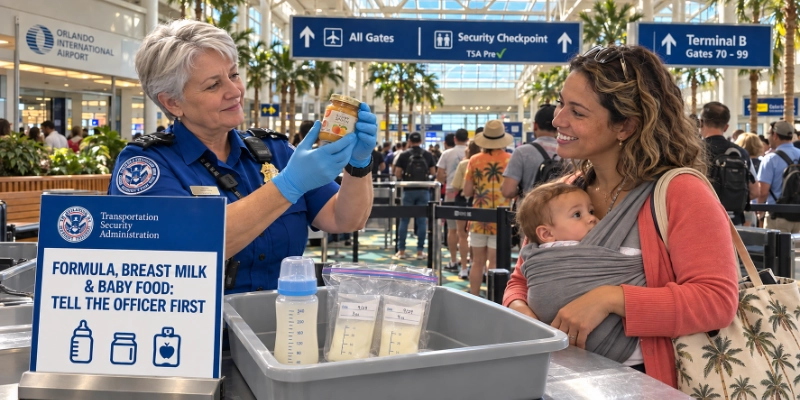
Yes, you can take baby food pouches on a plane. At TSA, puree pouches, baby and toddler food, formula, breast milk and toddler drinks are all treated as medically necessary liquids. That means you can carry them in quantities over 3.4 oz (100 ml), and they do not have to fit in the quart-sized bag. Two things apply: you have to tell the officer, and the items are screened separately.
This guide covers what counts as baby food, what the checkpoint looks like, where the gray areas are (yogurt tubes and applesauce for an older child), and the limits you meet when you land in the UK, the EU, Australia, New Zealand or Canada.
🍼 What counts as baby food at TSA
TSA’s exemption names its items: “formula, breast milk, toddler drinks, and baby/toddler food (to include puree pouches)”. Everything else follows the normal food rules.
| Item | Carry-on bag | What to know |
|---|---|---|
| Puree pouches and jars (baby or toddler food) | Over 100 ml allowed | Treated as a medically necessary liquid. Tell the officer; it is screened separately. |
| Powdered or liquid formula | Over 100 ml allowed | Does not need to fit in the quart bag. Tell the officer first. |
| Breast milk | Over 100 ml allowed | The child does not need to be with you. |
| Toddler drinks | Over 100 ml allowed | Named in TSA’s exemption together with formula and baby food. |
| Baby water and baby juice | Reasonable quantities | Screened separately from the rest of your bag. |
| Ice packs, freezer packs, gel packs, liquid-filled teethers | Allowed | Allowed even without the milk. Partly frozen or slushy ones get the extra screening described below. |
| Puffs, crackers, dry cereal, bread, plain fruit | No limit | Solid food has no limit in a carry-on or a checked bag. |
| Cheese sticks and solid cheese | No limit | Solid cheese is a solid. Creamy or spreadable cheese is not. |
| Yogurt tubes and applesauce for an older child | ⚠️ Gray area | TSA’s exemption names baby and toddler food. Ordinary yogurt is on TSA’s list as a 100 ml item. Expect the officer to decide. |
| Peanut butter or nut butter squeeze packs | ⚠️ 100 ml max | Spreads are liquids under the 3-1-1 rule, and nut butter packs are not baby food. |
🛃 What happens at the checkpoint
🔢 How much is “reasonable”?
TSA publishes no number. Its wording for baby food and baby water is “reasonable quantities”, and for formula and breast milk it says quantities over 3.4 oz are allowed. The practical limit is what your trip needs.
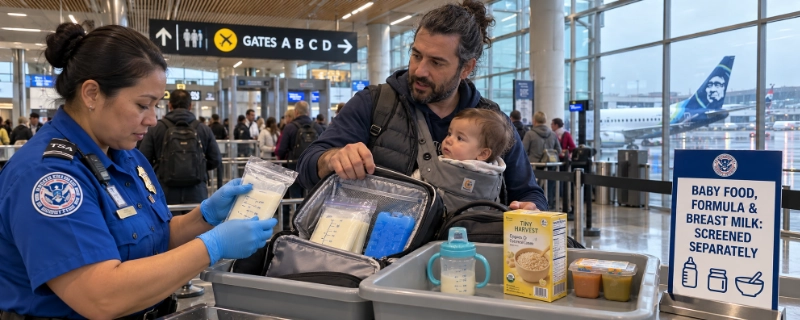
🧊 Ice packs, freezer packs and cooled milk
Ice packs, freezer packs, frozen gel packs and the other accessories used to keep formula, breast milk, toddler drinks and baby food cold are allowed in a carry-on, with or without milk in the bag. Liquid-filled teethers are allowed too.
🥣 Toddler snacks: solid or spreadable?
🛂 Landing abroad: the baby-food limits by country
TSA only covers the departure. When you land, the destination’s customs and agriculture rules decide, and all of these destinations want food declared. The figures below come from each country’s own authority.
 United Kingdom — up to 2 kg per person of powdered infant milk, infant food or special food needed for medical reasons. It must not need refrigeration before opening, and be in branded, unopened packaging. UK food page
 European Union — from outside the EU, no more than 2 kg of powdered infant milk, infant food and special food for medical reasons, with the same no-refrigeration and unbroken-packaging conditions. Meat and dairy are otherwise not allowed.
 Australia — infant formula for personal use up to 10 kg or 10 L if made in a foot-and-mouth-free country; breast milk up to 10 L for an infant in your care. You must declare it. Australia food page
 New Zealand — infant formula and milk powder must be commercially packaged, unopened and not need refrigeration, and you must declare them. Getting it wrong risks an instant NZD $400 fine. New Zealand food page
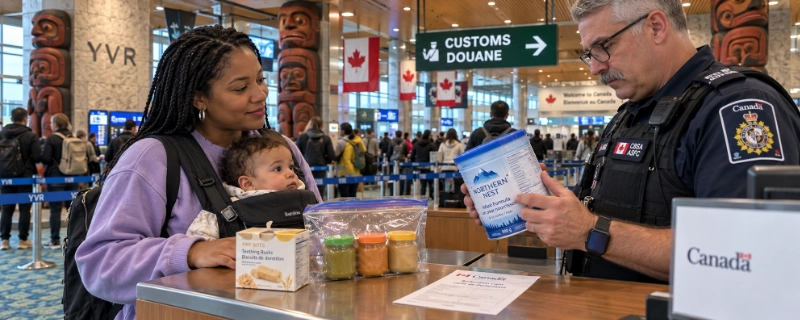
 Canada — infant formula up to 20 kg or 20 L. From the US, there are no restrictions; from other countries it must be commercially packaged, sealed and shelf-stable, and not labelled “keep refrigerated” or “keep frozen”. All food must be declared. Canada food page
Before you fly — checklist
TSA rules apply to screening at US airports, and other countries’ security rules differ. Customs limits change and each authority has the final word, so confirm current requirements with the destination’s customs or agriculture authority before you travel. Updated 2026.