What Food Can You Pass Through TSA vs. International Customs?
Food & Agriculture·Updated 2026·8 min read
Two checkpoints, two completely different questions — and food is the thing that trips up both.
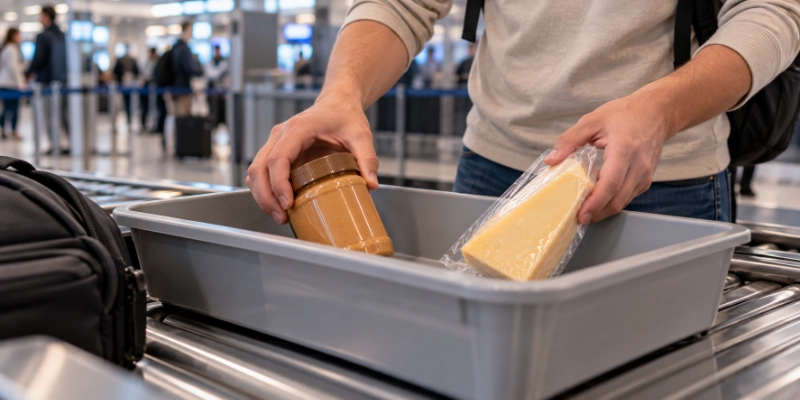
A jar of peanut butter and a vacuum-sealed wedge of cheese fail for two entirely different reasons. One gets pulled at security because it counts as a liquid. The other sails through security fine and gets confiscated an hour later at customs in the country you land in. Most travellers only prepare for one of these checkpoints — and it's usually the wrong one.
Two checkpoints, two different questions
🛫
TSA / airport security asks one question: is this a physical threat, or does it behave like a liquid? It does not care what country the food is going to.
🛂
Customs / border control asks a completely different question: could this food introduce a pest, disease, or contamination risk into the country you're entering? It does not care whether it passed security fine.
💡
Passing one checkpoint tells you nothing about the other. A food that's perfectly fine in your carry-on can still be illegal to bring into the country you're flying to.
TSA: it's the texture that matters, not the food
At security, food is judged exactly like any other item in your bag — if it flows, spreads, or can be poured, it falls under the 100ml liquids rule, no matter how ordinary it seems.
🚫
Treated as a liquid/gel — 100ml limit applies: peanut butter, honey, jam, syrup, hummus, salsa, cream cheese, yoghurt, soup.
✅
Treated as a solid — no quantity limit: bread, sandwiches, chips, cooked or cured meat, hard cheese, chocolate, dried fruit, baked goods.
📦
Vacuum sealing changes nothing at TSA. A vacuum-sealed jar of honey is still a liquid. A vacuum-sealed block of cheddar was already a solid and didn't need the seal.
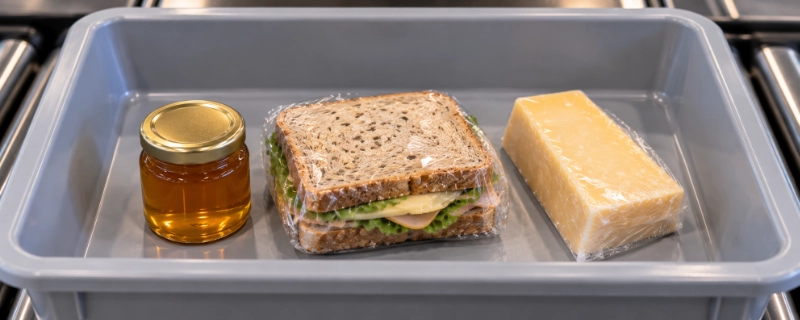
Same tray, three different rules — the honey is a liquid, the sandwich and cheese are not.
Customs: it's the origin and risk that matters, not the texture
Once you land, the question changes entirely. Customs and agricultural inspection exist to keep pests, plant disease, and livestock disease out of the country — not to police liquids.
🍎
Fresh fruit & vegetables — commonly restricted or banned outright; can carry fruit fly larvae, plant disease, or soil-borne pests.
🥩
Meat & dairy products — heavily restricted almost everywhere, vacuum-sealed or not; the risk is disease (like foot-and-mouth or swine fever), not spoilage.
🌱
Seeds, plants, soil — among the most tightly controlled items at any border; a few loose seeds in a pocket is enough to trigger a fine.
🍯
Honey — banned or restricted in several countries due to bee disease risk, regardless of how it fared at the TSA liquids check.
USA — USDA/APHIS bans most fresh fruit, vegetables, and meat unless from a pre-approved country and product listEuropean Union — no meat or dairy products may be brought in from outside the EU for personal use, with very limited exceptionsJapan — plant quarantine inspection required for any fresh produce, seeds, or plant material, in addition to customs
Australia and New Zealand run the strictest — and most heavily enforced — biosecurity checks of any developed countries, with instant on-the-spot fines. That's a big enough topic for its own breakdown.
The vacuum-sealed myth
⚠️
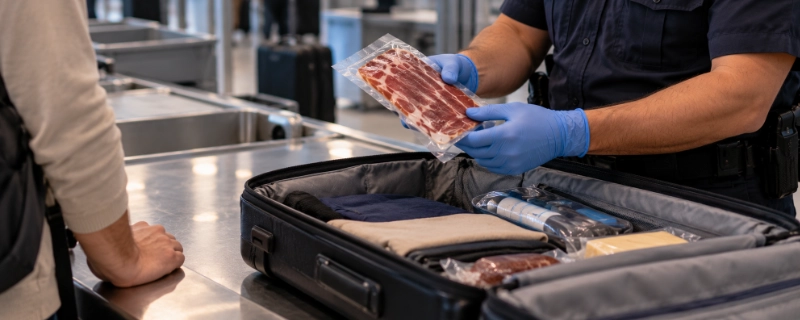
Vacuum sealing is not a customs exemption. It's a common belief that sealing cured meat or cheese airtight makes it acceptable to import — it doesn't. Customs restrictions are about the food itself and its country of origin, not its packaging. A vacuum-sealed salami is still salami.
Sealed tight, still restricted — the packaging was never the issue.
Why the customs declaration form matters more than the food
In most countries, simply carrying a restricted food item is not the offence that gets you in serious trouble — failing to declare it is.
1
If asked on the arrival card whether you're carrying food, plant, or animal products, answer honestly — even if you're unsure whether it counts.
2
Declared restricted food is usually just confiscated at the bin, often with no penalty at all.
3
Undeclared restricted food that's found is what triggers fines — because the form was answered incorrectly, not just because of the food.
Before you fly — checklist
1
Sort your food into liquid/gel vs. solid for TSA — spreads, sauces, and honey need the 100ml bag; bread, meat, and hard cheese don't.
2
Separately, check the destination country's customs rules for fresh produce, meat, dairy, and seeds — a TSA pass means nothing there.
3
Don't assume vacuum sealing changes anything at either checkpoint.
4
When the arrival card asks about food, plant, or animal products, declare it — the honest answer is almost always the cheaper outcome.
5
When in doubt about a specific item, leave it packed in checked luggage in original commercial packaging, or don't bring it at all.
Food import rules vary by country, change without notice, and are enforced differently at different borders. Always confirm current requirements with the destination's customs or agriculture authority before you travel. Updated 2026.
 USA — USDA/APHIS bans most fresh fruit, vegetables, and meat unless from a pre-approved country and product list
 European Union — no meat or dairy products may be brought in from outside the EU for personal use, with very limited exceptions
 Japan — plant quarantine inspection required for any fresh produce, seeds, or plant material, in addition to customs