Controlled Substances & Heavy Painkillers Across Borders
Medications·Updated 2026·9 min read
The medication that gets you through a flight is often the one a border officer looks at twice.
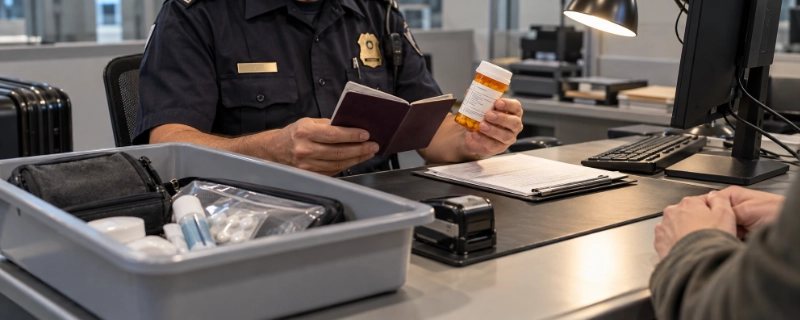
A Xanax for flight anxiety, an Ambien for a long-haul overnight, a codeine painkiller for a bad back — all ordinary, all legally prescribed, and all capable of turning into a real problem the moment they cross into a country that classifies them differently. This isn't about illegal drugs. It's about medication that's completely legal at home becoming a controlled or restricted substance somewhere else, with penalties that don't care how valid your prescription is.
The rule most countries actually apply: a reasonable personal supply
📅
Most countries with strict controlled-substance rules apply an unwritten or explicit cap around a 30-day supply for personal use — enough for a normal trip, not enough to look like distribution. Bringing three months' worth “just in case” is what tends to trigger questions, even when every pill is legitimately yours.
✅
Pack close to the amount you'll actually use for the length of your trip, plus a small buffer for delays.
⚠️
Longer trips or chronic conditions needing more than 30 days' supply often require an import permit arranged in advance — not something you can sort out at the airport.
Benzodiazepines: Xanax, Ativan, Valium
Anti-anxiety medication is one of the most commonly carried — and most commonly misjudged — categories, because it's so routine at home that travellers forget it's a controlled substance almost everywhere else too.
UAE — benzodiazepines are strictly controlled; undeclared Xanax or similar has led to real detentions at Dubai airport, prescription or notJapan — quantity limits apply to diazepam and similar; larger supplies need a Yakkan Shoumei import certificateSingapore — controlled; personal-use quantities generally accepted with a prescription and doctor's letter in hand
Sleep aids: Ambien, zolpidem
💊
Zolpidem (Ambien) is a controlled substance in several countries outside the US, including parts of the Middle East and Asia — treat it with the same documentation discipline as a benzodiazepine.
🛫
If you only need it for the flight itself, consider packing just the handful of doses required rather than a full prescription bottle — smaller quantities draw less scrutiny.
What the doctor's letter actually needs to say
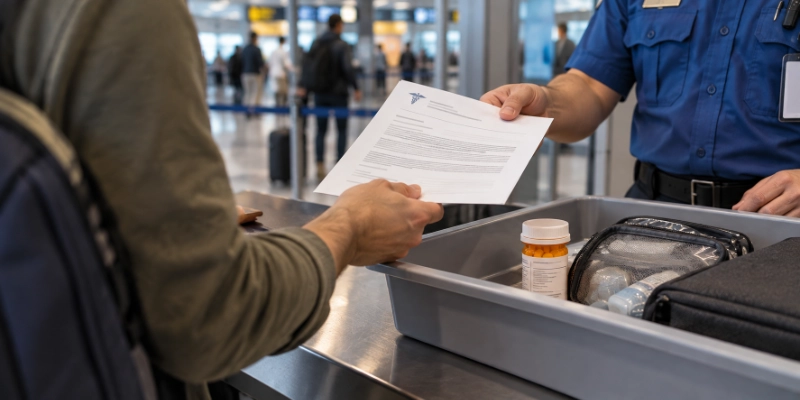
A vague note saying “patient takes medication for anxiety” does far less than one written to answer a border officer's actual questions.
1
The medical condition being treated, in plain terms.
2
The medication's generic (not just brand) name, dosage, and how often it's taken.
3
The exact quantity being carried and the trip length it covers.
4
The prescribing doctor's name, license number, and contact details, on letterhead if possible.
5
Dated within the last few months — an old letter can raise its own questions.
A properly written letter answers the question before it's asked — a vague one just invites a follow-up.
The surprise case: melatonin
😴
Melatonin is an over-the-counter supplement in the US and Canada — and a prescription-only medicine in the UK, most of the EU, and Australia. Travellers regularly pack a full bottle assuming it's as harmless as a vitamin, without realising it's regulated as a medicine the moment they land somewhere else.
It looks like a supplement. In several countries, it's legally a medicine — and travels under those rules instead.
🇬🇧
UK: melatonin is prescription-only. Bringing a personal supply for your own use is generally tolerated, but it cannot legally be sold or given away there.
🇪🇺
EU: status varies by country — several classify it as a medicine requiring a prescription, others allow low-dose versions over the counter.
🇦🇺
Australia: prescription-only; personal importation in small quantities for your own use is generally accepted.
ADHD stimulants and codeine: already covered in depth
Adderall, Vyvanse, Ritalin, and codeine-based painkillers follow their own country-by-country rules, permit processes, and outright bans — covered in full in our banned medications by country guide, including the specific import permit process for Japan, South Korea, Singapore, the UAE, and Greece.
Before you fly — checklist
1
Check your destination's specific rules for every controlled medication you're carrying — benzodiazepines, sleep aids, stimulants, and opioids each have their own status.
2
Pack close to a 30-day supply where possible; arrange an import permit in advance for longer trips.
3
Carry a detailed, recently dated doctor's letter naming the condition, medication, dosage, and quantity.
4
Keep medication in original, pharmacy-labelled packaging.
5
Don't assume a supplement is exempt — check melatonin and similar sleep aids against destination rules too.
6
When a destination's rules are unclear or unusually strict, ask your prescriber about a temporary alternative rather than risking it.
Controlled substance classifications, import limits, and permit requirements change by country and are enforced strictly at some borders. Always confirm current requirements with the destination's embassy or health ministry, and with your prescriber, before you travel. Updated 2026.
 UAE — benzodiazepines are strictly controlled; undeclared Xanax or similar has led to real detentions at Dubai airport, prescription or not
 Japan — quantity limits apply to diazepam and similar; larger supplies need a Yakkan Shoumei import certificate
 Singapore — controlled; personal-use quantities generally accepted with a prescription and doctor's letter in hand