Flying with Ozempic & Injectable Medications (2026)
Medications·Updated 2026·8 min read
Unlike a pill bottle, this medication has a temperature to manage and a needle to declare.
Ozempic, Wegovy, Mounjaro, Zepbound, and insulin pens are not liquids in the TSA sense, and they are not paperwork in most countries' sense either — until they are. The two things that make injectable medication different from a pill bottle are a cold chain that has to survive the whole trip and a needle that has to survive a security checkpoint. Both are manageable. Neither is optional to plan for.
Carry-on, not checked — no exceptions
🧊
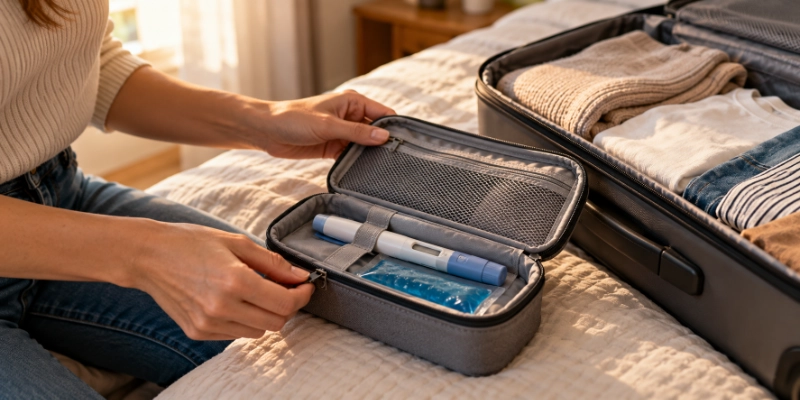
Never put an injectable in checked luggage. A cargo hold is not climate-controlled and can drop below freezing on a long flight. A frozen GLP-1 or insulin pen is compromised and the manufacturer's guidance is to discard it — there is no thawing it back to usable.
✅
GLP-1 pens (Ozempic, Wegovy, Mounjaro, Zepbound) and insulin are exempt from the 100ml liquids limit when medically necessary — carry as much as your trip needs.
✅
Unused needles and syringes travel in carry-on when packed with the medication they go with — keep them together in one clear, labelled bag.
✅
X-ray screening is safe for the medication — the radiation dose does not alter the drug.
✅
A doctor's note is not required for a domestic flight, but keep the pharmacy label on the pen box and carry the note anyway — it is what most international rules actually ask for.
💬
Declare it before the belt. Tell the officer you are carrying injectable medication and cooling packs before your bag goes through the X-ray — it is the difference between a five-second nod and a bag pulled for a manual check.
Insulin pumps and CGMs: choose your screening
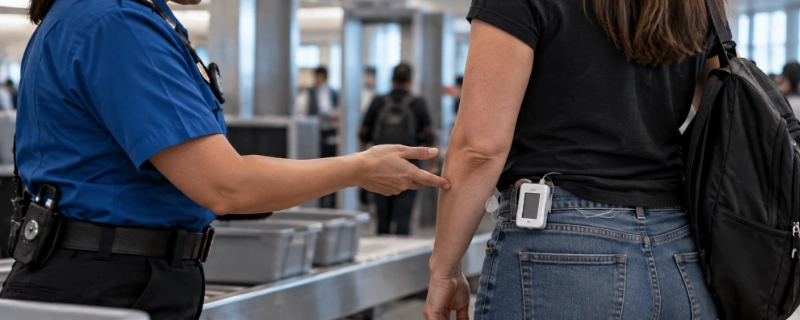
A worn device changes the calculus. Metal detectors are not a concern — pumps and continuous glucose monitors are built to tolerate them. Full-body imaging scanners are a different question, and the answer depends on the device, not the airport.
1
Check your specific pump and CGM manufacturer's guidance before you fly — some explicitly advise against imaging scanners and X-ray exposure, some don't.
2
Tell the officer you're wearing a pump or CGM before screening starts — verbally, or with a written notification card.
3
If your device's guidance is unclear or says avoid scanning, ask for a pat-down instead — it's a standard, available alternative, not a special favour.
4
You do not have to disconnect a pump for screening — say so before the officer asks you to.
A pat-down for a worn device is routine, not a red flag — ask for it if your manufacturer says to.
Keeping it cold for the whole trip
The cold chain is the part a pill bottle never makes you think about. Get the numbers wrong and the medication is the thing you lose, not just the schedule.
Unopened
2–8°C
Refrigerated, original packaging
✓ Keep cold
In use
< 30°C
Room temperature, up to 56 days
⚠ Time-limited
Frozen
0°C or below
Even briefly, even once
✗ Discard the pen
The trip doesn't end at the airport — the cold chain has to hold for every night away from home too.
🧊
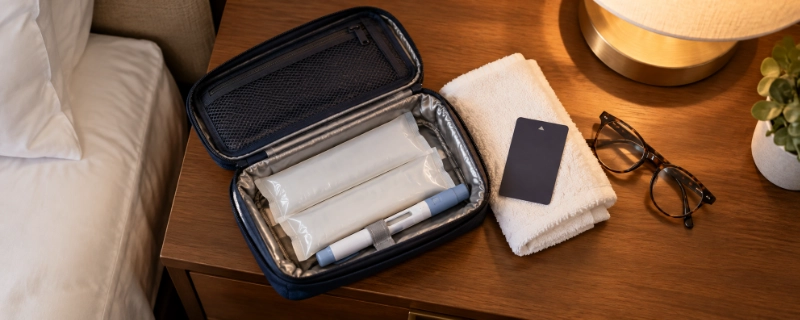
TSA's ice pack rule: gel or ice packs used to cool medication must be frozen solid at screening. Slushy or partially melted packs can be pulled aside for extra checks.
🏨
At the hotel: the minibar fridge works for unopened pens; a pen already in use is fine at room temperature under the 56-day/30°C limit — you don't need to refrigerate it once it's open.
✈️
Long layovers: a compact insulated pouch with a gel pack outlasts most connection times; refreeze or swap the pack at any airport food vendor if a layover runs long.
International rules are stricter than TSA's
TSA governs what goes through a US checkpoint. It says nothing about what the destination country will let you bring in, and that is where GLP-1 travel gets complicated — supply shortages and off-label weight-loss use have made several countries tighten personal-import rules.
Japan — restricted; personal-use import needs a doctor's letter covering the pens and needles, carried with the prescriptionUAE — needs Ministry of Health pre-approval; a prescriber letter on letterhead and, in most cases, an import permit arranged 2–4 weeks ahead, for up to a 3-month supplyTurkey — import permit required before travelThailand — declare any supply over a 30-day amount at customs, both entering and leaving; carry in original packaging with a doctor's note
📋
The rule that covers most destinations: carry your prescription and a clinician letter stating the medication, dose, and medical necessity, keep the pen in its original labelled packaging, and declare it at customs rather than waiting to be asked. It will not stop every question, but it answers most of them on the spot.
Before you fly — checklist
1
Pack every pen, vial, and needle in carry-on — never checked luggage.
2
Keep the pharmacy label on the box and carry a doctor's letter, even for domestic flights.
3
Freeze cooling packs solid before you leave for the airport.
4
Check your pump/CGM manufacturer's scanner guidance and decide on a pat-down in advance if needed.
5
Declare injectable medication and cooling packs before your bag goes through the X-ray.
6
For international trips, check the destination's import rules weeks ahead — some require a permit that can't be arranged at the border.
7
Know the temperature limits: 2–8°C unopened, under 30°C once in use for up to 56 days, never frozen.
Medication rules and import requirements change by country and are updated without much notice. Always confirm current requirements with the destination's embassy or health ministry, your prescriber, and your device manufacturer before you travel. Updated 2026.
 Japan — restricted; personal-use import needs a doctor's letter covering the pens and needles, carried with the prescription
 UAE — needs Ministry of Health pre-approval; a prescriber letter on letterhead and, in most cases, an import permit arranged 2–4 weeks ahead, for up to a 3-month supply
 Turkey — import permit required before travel
 Thailand — declare any supply over a 30-day amount at customs, both entering and leaving; carry in original packaging with a doctor's note