The 3-1-1 Liquid Medication Exemption: How to Bypass the 100ml Rule
Medications·Updated 2026·8 min read
It never has to go in the 1-litre bag — it has its own rule entirely.
Cough syrup, liquid antibiotics, eye drops, a nutritional shake for a medical condition — the standard 100ml liquids rule was never built with these in mind, and that's exactly why a specific exemption exists for them. Most travellers have never heard of it, which is why a 200ml bottle of a child's antibiotic keeps ending up confiscated at security when it never needed to be.
The 3-1-1 rule, and why medication skips it
The standard rule — 3.4oz/100ml containers, 1 quart-sized bag, 1 bag per passenger — exists to limit the volume of unknown liquid at a checkpoint. Medically necessary liquids are not unknown; they're declared, and that declaration is what unlocks the exemption.
💊
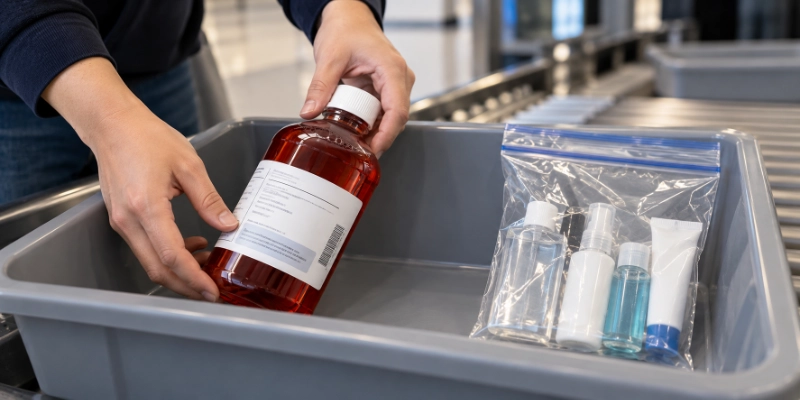
Medically necessary liquids, gels, and aerosols are exempt from the 100ml limit and do not need to fit in the quart-sized bag. This covers prescription and over-the-counter liquid medication, and there's no fixed cap — TSA guidance says to bring what's “reasonably needed” for the length of the trip.
Insulin and other injectable medications, along with the liquids that go with them.
🧴
Medical creams, gels, and ointments prescribed for a condition.
🥤
Nutritional shakes and liquid meal replacements needed for a medical condition.
🧊
Gel or ice packs used to keep medication cold — exempt as long as they're frozen solid at the checkpoint.
🍼
Breast milk, formula, and juice for infants and toddlers travel under a similar exemption, even without a prescription behind them.
How to actually use the exemption at the checkpoint
1
Take the medication out of your bag and keep it separate from the rest of your belongings before you reach the X-ray belt.
2
Declare it verbally to the officer before screening begins — tell them you're carrying medically necessary liquid medication over the standard limit.
3
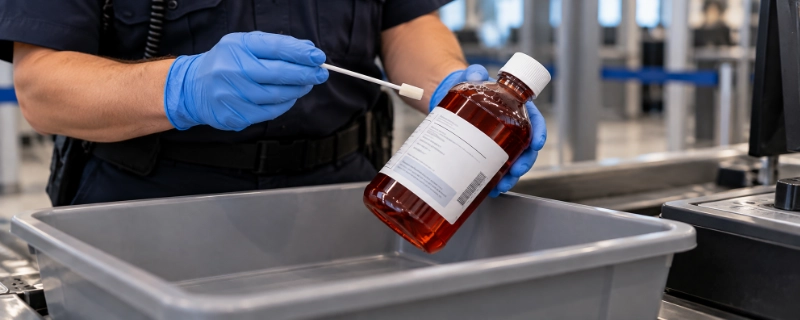
Expect additional screening. The container is typically tested with an X-ray, and possibly a vapor or liquid test strip, rather than just eyeballed. This takes a few extra minutes, not a few extra hours.
4
You can request a visual inspection instead of X-ray for certain medications, but you must ask before screening starts.
5
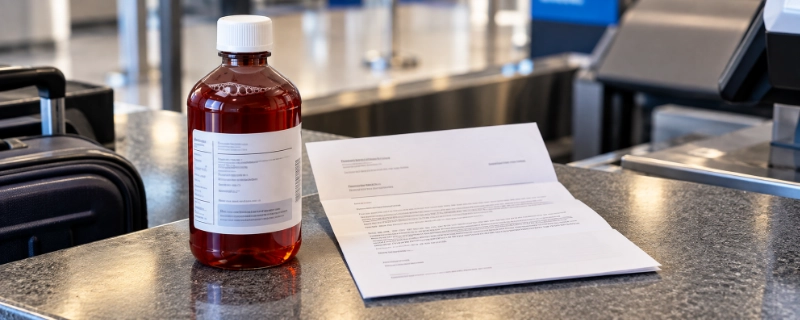
A prescription label or pharmacy printout helps but is not strictly required domestically — it speeds up the conversation more than it's legally necessary.
The extra screening is the trade-off for skipping the 100ml limit — a couple of minutes, not a confiscation.
International flights: the exemption still exists, but expect more paperwork
Most countries with a 100ml-style liquids rule carry a similar medical exemption — but international checkpoints lean much more heavily on documentation than TSA does.
UK — liquid medication over 100ml is allowed with proof of need (prescription or doctor's letter); larger supplies may need extra verificationEU (Schengen) — medical liquid exemption applies with supporting documentation; carry it in your hand luggage, declared separately at screeningAustralia — medical liquids over 100ml permitted with a prescription, doctor's letter, or pharmacist-labelled container
Domestically, a label is a convenience. Internationally, a doctor's letter is often the thing that actually gets you through.
Mistakes that cause unnecessary delays
❌
Packing medical liquid inside the 1-litre bag with everything else. It should be separate and declared — mixing it in slows down screening and can prompt a full bag search.
❌
Staying silent and hoping it passes unnoticed. Declaring before screening is what activates the exemption; an undeclared oversized liquid just looks like a rule violation.
❌
Bringing a slushy, partially melted gel pack. It must be frozen solid to qualify — a soft pack can be pulled aside or confiscated.
❌
Assuming the exemption is automatic internationally. Carry a prescription or doctor's letter for any international flight — some checkpoints won't apply the exemption without it.
Before you fly — checklist
1
Keep liquid medication separate from your other bags and your regular liquids bag.
2
Declare it to the officer before your bag goes through the X-ray.
3
Only bring the amount reasonably needed for the length of your trip.
4
Freeze gel or ice packs solid before you leave for the airport.
5
Carry a prescription label or doctor's letter, especially for international flights.
6
Budget a few extra minutes at security for the additional screening this exemption requires.
Liquid medication screening procedures vary by airport, airline, and country, and can change without much notice. Always confirm current requirements with TSA or the relevant security authority before you travel. Updated 2026.
 UK — liquid medication over 100ml is allowed with proof of need (prescription or doctor's letter); larger supplies may need extra verification
 EU (Schengen) — medical liquid exemption applies with supporting documentation; carry it in your hand luggage, declared separately at screening
 Australia — medical liquids over 100ml permitted with a prescription, doctor's letter, or pharmacist-labelled container