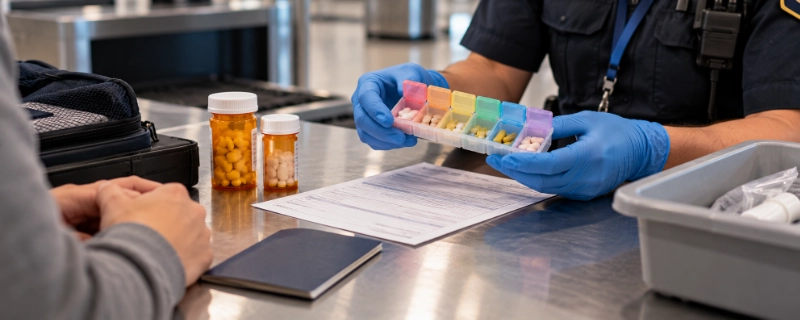
Daily Pill Organizers vs. Original Prescription Bottles: What TSA and Customs Actually Require
Medications·Updated 2026·8 min read
Fine for a US domestic flight. A different story the moment you land somewhere else.
A weekly pill organizer saves real suitcase space — one flat case instead of five or ten bulky prescription bottles. It's also the single most common thing travellers ask airport security about, because the honest answer changes depending on where you're flying and where you're landing. TSA is the easy part. It's the layer above TSA — state law and international customs — that actually decides whether loose, unlabelled pills cause a problem.
TSA's actual position: pill organizers are fine
✅
TSA does not require medication to be in its original, pharmacy-labelled bottle for a US domestic flight. A weekly pill organizer, a daily pillbox, or loose pills in a labelled container all pass through security screening the same way — TSA officers are checking what's in the bag, not verifying prescription paperwork.
✅
Pill organizers, weekly sorters, and unmarked pill cases are all permitted in carry-on and checked baggage.
✅
No limit on quantity of solid medication in pill form — unlike liquids, tablets and capsules aren't subject to the 100ml rule.
💬
You can request a visual inspection instead of X-ray for your medication, though it isn't required.
Where it stops being simple: state law and destination customs
TSA screens what goes through the checkpoint. It has no say over what happens once you're in a different state or a different country — and that's exactly where the pill organizer question gets complicated.
🇺🇸
Some US states have their own laws requiring controlled substances (like Xanax, Adderall, or opioid painkillers) to be in their original, labelled container — a local police stop, not TSA, is where this actually gets enforced.
🌍
Most international customs authorities expect medication — especially controlled or prescription-only substances — to be identifiable and matched to the passenger carrying it. Loose, unlabelled pills in a weekly sorter are much harder to explain at a border than at a domestic checkpoint.
UK — recommends original packaging with your name for any prescription medication, especially controlled drugsEU (Schengen) — original labelling expected for controlled substances; a Schengen medical certificate is required for some narcotic-based medicinesAustralia — expects medication in original packaging matching the traveller's name, particularly for controlled or prescription drugs
The question a customs officer actually asks isn't “why is this in a sorter” — it's “can you prove this is yours.”
How to use a pill organizer without creating a problem
You don't have to choose between packing efficiently and staying compliant — you just need paperwork that travels with the organizer, not inside it.
1
Keep the original pharmacy bottles in your luggage too, even if the pills themselves are sorted into the organizer for the trip. An empty labelled bottle is proof enough for most checks.
2
Photograph or print the pharmacy label for each medication before you decant it — a phone photo of the label next to the pill organizer answers most questions on the spot.
3
Carry a doctor's letter or prescription printout listing each medication, dosage, and your name — especially for controlled substances like ADHD stimulants, opioids, or benzodiazepines.
4
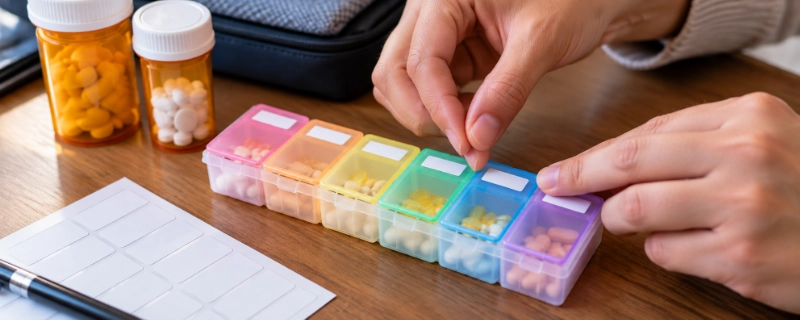
Use pharmacy label stickers on the organizer itself if your pharmacy offers them — small adhesive labels that identify each compartment's contents without needing the full bottle.
5
For international or controlled-substance travel, default to original bottles. The space you save with a pill organizer isn't worth the risk for a Xanax, Adderall, or codeine prescription crossing a border.
A label sticker on each compartment does what the original bottle used to — identify what's inside and whose it is.
Before you fly — checklist
1
For a domestic flight with non-controlled medication, a pill organizer alone is fine at TSA.
2
For controlled substances (stimulants, opioids, benzodiazepines) on any flight, keep the original labelled bottle with you, even if you also use an organizer for convenience.
3
For any international trip, carry a doctor's letter or prescription printout naming each medication and matching your passport name.
4
Photograph pharmacy labels before decanting pills into an organizer, in case you're asked to identify something.
5
Check the destination country's specific rules for your medication — original packaging requirements vary and some substances need advance permits regardless of how they're packed.
Medication packaging and identification requirements vary by state, airline, and destination country, and change without much notice. Always confirm current requirements with TSA, your airline, and the destination's embassy or customs authority before you travel. Updated 2026.
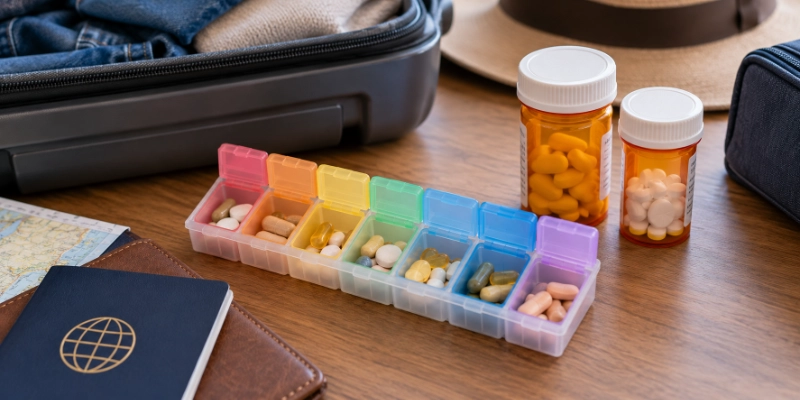
 UK — recommends original packaging with your name for any prescription medication, especially controlled drugs
 EU (Schengen) — original labelling expected for controlled substances; a Schengen medical certificate is required for some narcotic-based medicines
 Australia — expects medication in original packaging matching the traveller's name, particularly for controlled or prescription drugs