Carry-On Size Limits by Airline (2026): The Real Chart
Packing Rules·Updated 2026·8 min read
There is no universal carry-on size — only about a dozen different ones an airline can hold you to.
Search “carry-on size limits” and you will get a hundred versions of the same number: 22 x 14 x 9 inches. That figure is real — but it belongs to American, Delta, United, JetBlue and Alaska. Cross over to Southwest, Frontier, Ryanair, Wizz Air or Lufthansa and the “standard” bag is either too big or too small, and the airline holding the sizer frame has the final word, not the tape measure you used at home.
No international body regulates carry-on dimensions. The International Civil Aviation Organization (ICAO) sets safety rules — what can catch fire, what has to stay out of the cargo hold — but bag size is a business decision each airline makes on its own. That is why the same rolling suitcase can board free on one airline and get gate-checked or charged a fee on the very next flight.
22×14×9in
US majors' standard size (American, Delta, United, JetBlue, Alaska)
40×30×20cm
Ryanair & Wizz Air's free personal-item size
8kg
Lufthansa's carry-on weight cap — one of the strictest
2027
When the EU's new free-bag law actually takes effect
US domestic airlines: one real standard, two exceptions
Five of the seven major US carriers converge on the same 22 x 14 x 9 inch box, measured including wheels and handles. Southwest goes bigger. Frontier makes you pay for the privilege.
American Airlines
22 × 14 × 9 in
Wheels and handles included. No published weight limit on the standard cabin bag.
No weight limit
Delta Air Lines
22 × 14 × 9 in
Same footprint as American — the closest thing the US has to a universal carry-on size.
No weight limit
United Airlines
22 × 14 × 9 in
Basic Economy on many routes drops you to a personal item only, no rolling bag.
Fare-restricted
JetBlue
22 × 14 × 9 in
Blue Basic fares also cut the allowance to a personal item only.
Fare-restricted
Alaska Airlines
22 × 14 × 9 in
Matches the American/Delta footprint, with no weight cap on the cabin bag.
No weight limit
Southwest Airlines
24 × 16 × 10 in
The most generous US major — bigger box, two free bags, no weight limit.
No weight limit
Frontier Airlines
24 × 10 × 16 in
Carry-on isn't free on Frontier — it's a paid add-on capped at 35 lb. The free personal item is only 18 × 14 × 8 in.
35 lb cap + fee
The frame at the gate is the only measurement that counts — not the spec sheet from the store.
European & budget carriers: two bags, two different games
US airlines mostly argue about one bag. European low-cost carriers split the allowance into two: a free personal item that fits under the seat, and a larger cabin bag that increasingly comes with a fee attached.
Ryanair
40 × 30 × 20 cm
The only genuinely free bag. A larger 55 × 40 × 20cm overhead bag exists only as a paid Priority add-on, capped at 10kg.
10kg cap on paid bag
Wizz Air
40 × 30 × 20 cm
Same split as Ryanair: a free small bag under the seat, and a 55 × 40 × 23cm overhead bag reserved for Wizz Priority fares.
Priority-only overhead
easyJet
45 × 36 × 20 cm
The included cabin bag is genuinely free, goes under the seat, and carries no published weight limit. A larger 56 × 45 × 25cm bag costs extra.
No weight limit
British Airways
56 × 45 × 25 cm + 40 × 30 × 15 cm
Two free bags as standard — a full cabin case plus a personal item — with a combined 23kg weight cap across both, not per bag.
Two free bags
Lufthansa
55 × 40 × 23 cm
One of the strictest weight caps among major carriers at 8kg (17.6 lb), plus a free 40 × 30 × 15cm personal item.
8kg cap
🇪🇺
The EU's free-bag law won't end the size wars
Adopted 7 July 2026, the EU261 passenger-rights reform guarantees every passenger a free personal item up to 40 x 30 x 15cm, plus a small cabin bag up to 100cm combined (length + width + height) and 7kg, at no extra charge.
It does not set one size for the larger overhead cabin bag itself — airlines keep choosing their own cabin-bag dimensions, which is why Ryanair's, Wizz Air's and Lufthansa's numbers above will still differ from each other.
The rules do not take effect until the second half of 2027, so nothing changes for a trip booked in 2026.
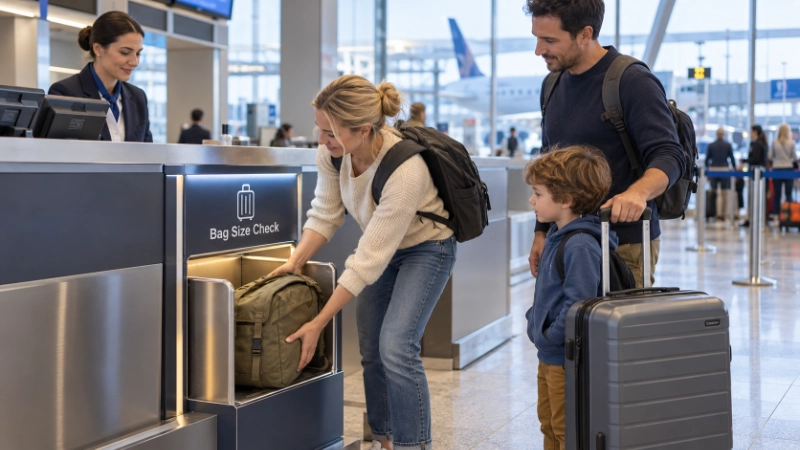
Personal item or cabin bag? On a European low-cost carrier, that distinction decides whether you pay.
Why the same bag passes on one airline and gets pulled on the next
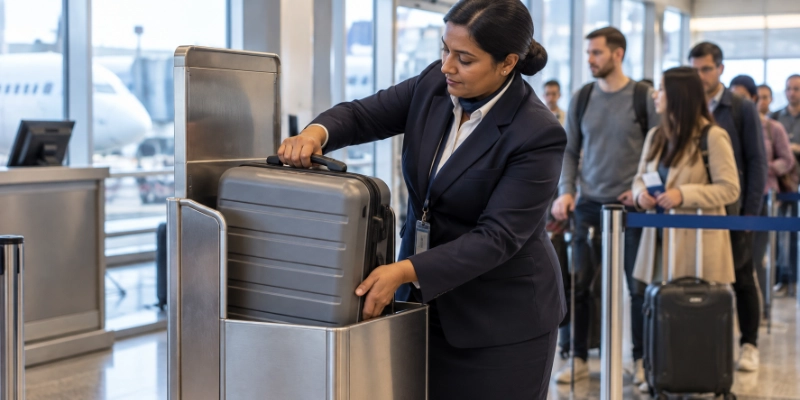
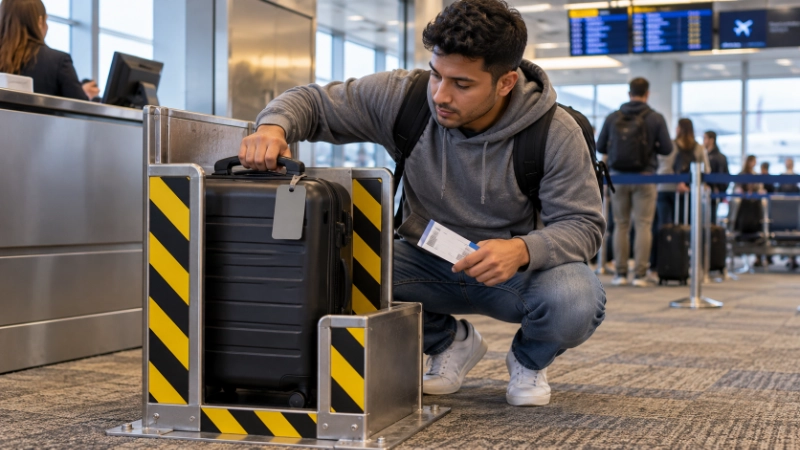
Enforcement is not consistent even within a single airline. A soft-sided bag that used to compress into a sizer frame gets caught more often now, because most carriers that actually enforce size have switched to rigid metal frames instead of the flexible fabric ones. Weight checks are inconsistent too: US majors almost never weigh a carry-on, while European low-cost carriers will pull a bag off a hanging scale at the gate if the boarding queue looks calm enough to check.
Fare class matters as much as the airline. Basic Economy on United and Blue Basic on JetBlue both quietly downgrade a “standard” booking to a personal-item-only allowance. On Ryanair and Wizz Air, anything bigger than the free personal item requires a Priority fare, whether or not the airline chooses to enforce it at your specific gate.
1
If you fly a mix of airlines, buy to the smallest common size that still boards free everywhere — around 45 x 36 x 20cm (18 x 14 x 8in) — not the largest number any single airline allows.
2
Measure your bag with wheels, handles, and any external pockets extended. That is what the gate sizer measures, not the manufacturer's empty-and-collapsed spec.
3
On European budget carriers without a Priority or Plus fare, weigh your bag at home — a bag that fits the frame can still get pulled aside for being overweight.
4
Do not count on a soft-sided bag compressing into the sizer. Most airlines that enforce size now use a rigid frame, not a flexible one.
5
Check your specific fare class, not just the airline. Basic Economy, Blue Basic, and non-Priority European fares often cut you down to a personal item only.
Airlines change carry-on dimensions, weight limits, and fare-class rules with little notice. Confirm the current policy on your airline's own website before you fly. Updated 2026.