Japan Customs Declaration (2026): Visit Japan Web QR Code or Paper Form?
Customs & Money·Updated 2026·7 min read
Two ways to declare in Japan. The questions are the same — only the paperwork changes.
Every passenger entering Japan has to give Japan Customs a declaration. There are two ways to do it: online through Visit Japan Web, which gives you a QR code, or on the paper form (C-5360) handed out on the plane. Japan Customs recommends Visit Japan Web, but it is optional — the paper form is still accepted.
Both ask the same questions. The part that trips people up is not filling in the boxes, it is knowing when to answer Yes. This guide covers which method to use, exactly what the paper form asks, and the Japan limits that decide your answers.
¥200,000
Other goods — total overseas market value
¥1M
Cash and securities — declare above this
3
Bottles of alcohol (about 760 ml each)
200
Cigarettes duty-free
QR code or paper form: which should you use?
📱
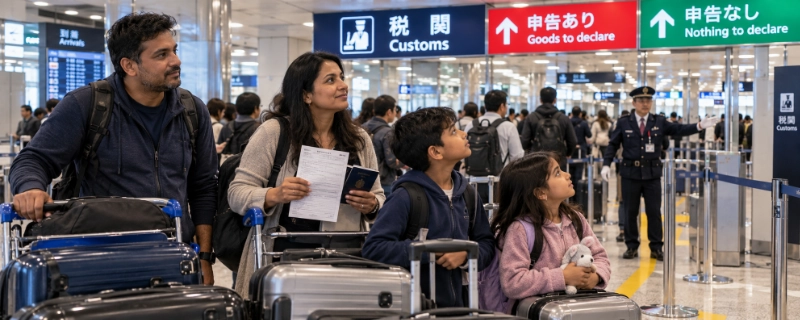
Visit Japan Web (QR code). You enter your details online before the trip and get a 2D code that carries your declaration. At the airport you hold the code and your IC (chip) passport over the scanner at an electronic customs declaration gate. These gates operate at 7 international airports.
📄
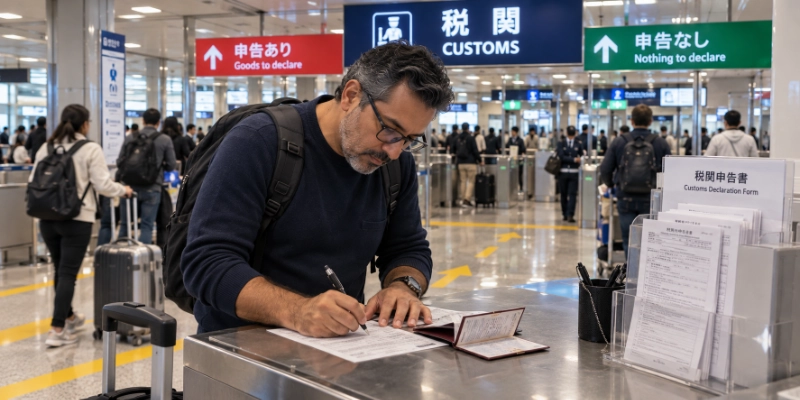
Paper form C-5360. Handed out on the plane or ship, or available in the airport customs area. You can also print it on A4 paper in advance. It comes in 13 languages, and only one written declaration per family is required.
🚫
Old app codes no longer work. Codes from the earlier Customs Declaration app became invalid on 25 January 2024. Only Visit Japan Web codes are accepted.
🔍
A QR code does not skip inspection. Japan Customs says that even when you declare electronically, your baggage may still be inspected by customs officers. Neither method means a shorter wait or a guaranteed pass.
Travelling as a family? One written declaration covers everyone.
What the paper form asks
The online version asks the same things. At the top you fill in your flight number, point of embarkation, date of arrival, name, address in Japan (your accommodation), nationality, occupation, date of birth, passport number, and how many family members are travelling with you. Then come three questions.
1
Are you bringing any of these into Japan? (Yes/No for each) ① Narcotic drugs, firearms, explosives and other prohibited items ② Meat products, vegetables, fruits, animals, plants and other restricted items ③ Gold bullion or gold products ④ Goods (purchases, souvenirs, gifts) exceeding your duty-free allowance ⑤ Commercial goods or samples ⑥ Anything someone else asked you to bring into Japan — including a suitcase or bag you were given
2
Cash, cheques (including traveller’s cheques), promissory notes or securities over ¥1,000,000 or the equivalent, or precious metals over 1 kg? If Yes, you also submit a separate “Declaration of Carrying of Means of Payment” form to customs.
3
Do you have unaccompanied articles? If Yes, submit the form in duplicate. Unaccompanied articles must be imported within 6 months of your arrival date.
If you answer Yes to anything above, list those belongings under “Description of Accompanied Articles” on the back of the form, then sign to confirm the details are true.
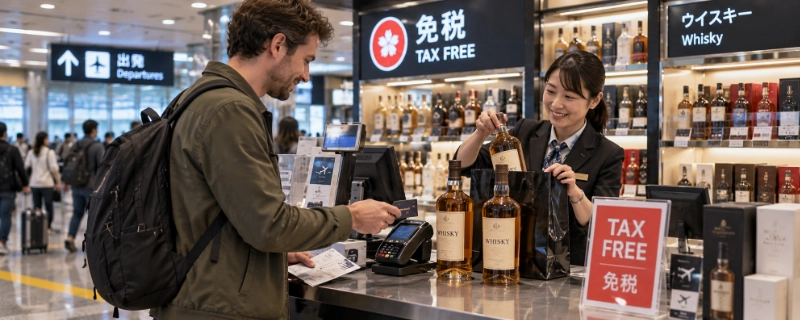
Everything you bought abroad or in a duty-free shop counts toward the limits below.
The Japan limits that decide Yes or No
Question 1 ④ (“exceeding duty-free allowance”) and Question 2 depend on these Japan Customs limits. The form’s notice is explicit: you must declare all articles you bought abroad or in duty-free shops and are bringing into Japan.
🍾
Alcohol: 3 bottles per adult, about 760 ml each.
🚬
Tobacco: 200 cigarettes, or 50 cigars, or 10 packages of heat-not-burn tobacco, or 250 g of other tobacco. If you bring more than one kind, the total allowance is the equivalent of 250 g.
🌸
Perfume: 2 ounces (about 56 ml).
🛍️
Other goods: ¥200,000 total overseas market value. Items worth less than ¥10,000 each are left out of the calculation, and there is no exemption for a single item worth more than ¥200,000.
💴
Cash and securities: declare anything over ¥1,000,000 or its equivalent. This covers cash, cheques, traveller’s cheques, promissory notes and securities.
⚠️
Answer Yes for restricted items, even if they seem harmless. Meat products, fruit, vegetables, plants and animals go under Question 1 ②. Gold bullion goes under ③, and a bag or item that someone else asked you to carry goes under ⑥. Illegal imports can bring fines of up to ¥3 million for individuals and imprisonment of up to 3 years.
Before you land — checklist
1
Choose your method: Visit Japan Web (recommended, optional) or the paper form.
2
Using the QR code? Complete it before you fly and keep the code on your phone, with your IC passport ready.
3
Using paper? Take the form from the cabin crew, or print it on A4 in advance. One form per family.
4
Add up everything you bought abroad and in duty-free shops, gifts included, against the ¥200,000, alcohol, tobacco and perfume limits.
5
Carrying more than ¥1,000,000 in cash or securities? Answer Yes to Question 2 and fill in the means-of-payment form.
6
Check Question 1 honestly: food, plants, gold, commercial goods and items carried for someone else all count.
7
Expect that officers may still inspect your bags, whichever method you used.
Customs rules, allowances and forms change, and Japan Customs has the final word. Always confirm the current requirements with Japan Customs before you travel. Updated 2026.