The $10,000 Cash Declaration Rule Explained (2026)
Customs & Money·Updated 2026·9 min read
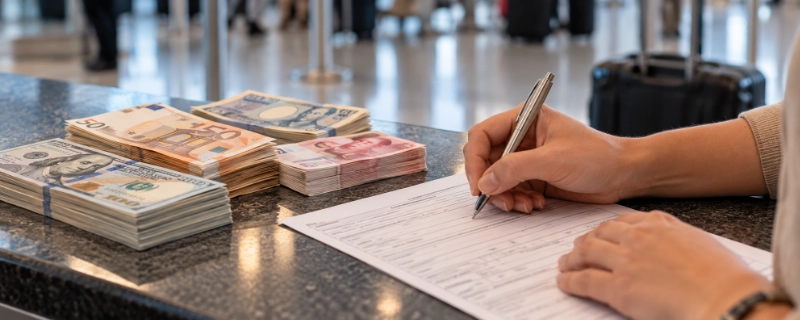
Carrying $10,000 in cash is legal everywhere. Not declaring it is a federal offence almost everywhere.
Ten thousand dollars sounds like a number for smugglers, not for someone flying home with wedding gift cash or an inheritance from a relative abroad. It isn't. The $10,000 threshold catches ordinary travellers every year — people who did nothing wrong except assume that if the money is legally theirs, they don't need to say anything about it.
The rule is simpler than it looks, and the penalty for getting it wrong has nothing to do with whether the cash is legitimate. In most countries, undeclared cash over the threshold can be seized on the spot — even when you can prove exactly where it came from.
Why the threshold exists
🏦 Where the rule comes from
📜
1970 · United StatesThe Bank Secrecy Act creates the first cash reporting requirement, aimed at money laundering through the banking system rather than air travel specifically.
🌍
1989 · FATF foundedThe Financial Action Task Force sets international anti-money-laundering standards. Cross-border cash declaration at a fixed threshold becomes a near-universal recommendation.
✈️
TodayMost countries with international airports enforce a version of the same rule — a fixed cash threshold, declared to customs, in both directions.
What actually has to be declared
The $10,000 figure doesn't just mean banknotes in a money belt. Customs authorities count it as the total value of every monetary instrument you're carrying, added together.
💵
Cash — any currency, converted to the local threshold currency at the current exchange rate.
🧾
Traveller's cheques, cashier's cheques, money orders — even if unsigned or made out to someone else.
📄
Negotiable instruments — bearer bonds, promissory notes, anything that can be cashed by whoever holds it.
🪙
In several countries, high-value precious metals or gold coins carried as a store of value count too.
👪
It's counted per family or travel group, not per person. Two spouses each carrying $6,000 are carrying a combined $12,000 — over the threshold — even though neither individual amount looks like it qualifies.
The threshold, country by country
$10,000
United States — FinCEN Form 105, both directions
€10,000
European Union — declared entering or leaving the bloc
£10,000
United Kingdom — Border Force cash declaration
Canada — CAD $10,000 or equivalent, declared to the CBSAAustralia — AUD $10,000 or foreign equivalent, declared to Australian Border ForceIndia — US$5,000 in foreign cash (US$10,000 total including instruments) — plus a separate, much stricter limit on Indian rupeesUAE — AED 60,000 (≈ US$16,300), declared to UAE customsChina — US$5,000 in foreign currency or CNY 20,000 — larger amounts need a permitSingapore — SGD 20,000 or equivalent, declared to Singapore Customs
The form takes two minutes. Getting stopped without having filled it out takes considerably longer.
How to actually declare it
1
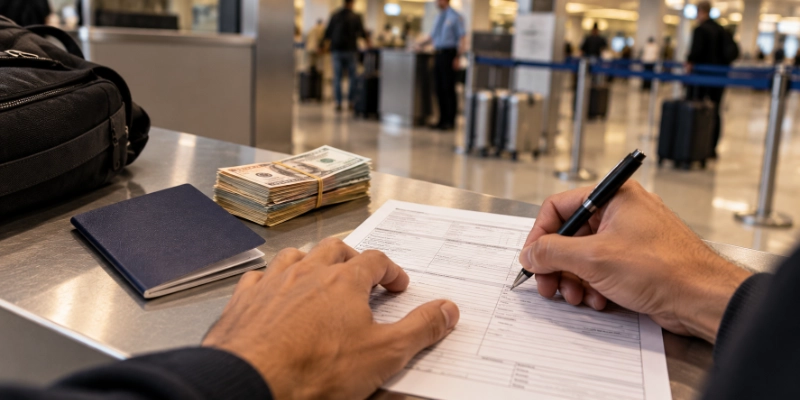
Fill out the form before you reach the customs desk — most airports have it at check-in or in the arrivals hall, and US CBP's Form 105 can be completed online in advance.
2
Declare the total, not just the cash — add up every traveller's cheque, money order, and instrument alongside the banknotes.
3
It applies in both directions — leaving the country with $10,000+ requires the same declaration as arriving with it.
4
Keep proof of where the money came from — a bank withdrawal slip, a gift letter, a sale document. You don't need it to make the declaration, but it's the fastest way through if you're asked.
5
Travelling as a family or group? Agree on one declaration covering the combined total before you reach the desk.
What happens if you don't declare
⚠️
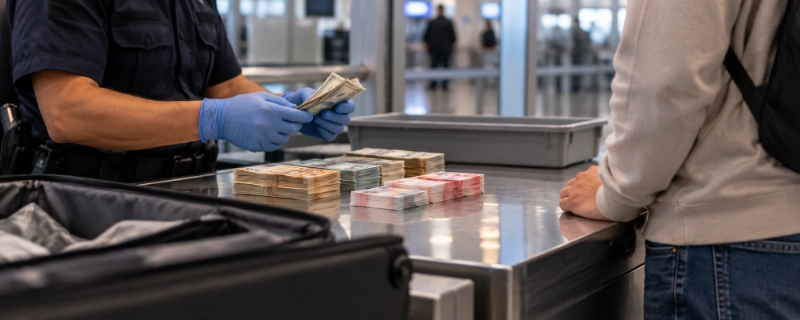
Undeclared cash over the threshold can be seized on the spot. In the US, civil asset forfeiture law allows this even without any criminal charge being filed. Getting the money back afterward means proving its origin through a legal process that can take months, with no guarantee of success.
Perfectly legal money. An undeclared amount is still the offence — not the cash itself.
🚫
“Structuring” — splitting cash between travel companions specifically to keep each person's share under the threshold — is a separate federal crime in the US, regardless of whether the total was ever going to be declared honestly.
💸
Civil forfeiture doesn't require a conviction. Money can be seized and kept by the government even if no charges are ever filed against you.
⏳
Getting seized funds back typically means hiring a lawyer and filing a formal petition — a process that outlasts most people's patience and often costs more than it's worth for smaller seizures.
Common misconceptions
❌
“It's illegal to carry more than $10,000.” False. There's no cap on how much cash you can carry. The only requirement is declaring amounts over the threshold.
❌
“The limit resets per calendar year.” False for cash carried in person. It's a per-trip, per-crossing threshold, not an annual allowance.
❌
“Wire transfers and card payments count too.” False. Only physical cash and monetary instruments carried in person or in luggage trigger this declaration. Electronic transfers are reported separately, by banks.
⚠️
“Cryptocurrency isn't covered.” Increasingly false. Several countries, including the US, have moved to include cryptocurrency held on hardware wallets or seed phrases in cash declaration rules — check current guidance before assuming it's exempt.
Before you fly — checklist
1
Add up all cash, cheques, money orders, and negotiable instruments you're carrying — as one combined total.
2
Check the threshold for both your departure and destination country — they aren't always the same figure.
3
Travelling with family or companions? Agree on one combined declaration before you reach customs.
4
Fill out the declaration form in advance where the option exists — most customs agencies let you do this online.
5
Carry proof of the money's origin, even though you aren't required to show it to make the declaration itself.
6
Declare honestly the first time — a wrong or incomplete declaration carries its own separate penalty.
7
Never split cash among travel companions specifically to duck the threshold — that is structuring, and it is its own offence.
Cash declaration thresholds, forms, and penalties change by country and are enforced differently at different borders. Always confirm the current requirement with the customs authority of every country you're entering or leaving before you travel. Updated 2026.
 Canada — CAD $10,000 or equivalent, declared to the CBSA
 Australia — AUD $10,000 or foreign equivalent, declared to Australian Border Force
 India — US$5,000 in foreign cash (US$10,000 total including instruments) — plus a separate, much stricter limit on Indian rupees
 UAE — AED 60,000 (≈ US$16,300), declared to UAE customs
 China — US$5,000 in foreign currency or CNY 20,000 — larger amounts need a permit
 Singapore — SGD 20,000 or equivalent, declared to Singapore Customs